The project fieldbook

Four projects.
A shared inquiry.

Agent infrastructure, a physical prototype, a perception pipeline and an engineering method. Each begins with a different problem; each asks what useful intelligence requires.

These are independent projects at different stages. The connections describe a research direction, rather than a completed integrated system.

01 / Flagship agent infrastructure

In development

AEGIS-COGNITION

From intent
to evidence.

The core agent infrastructure project: a small Python-facing API, with Rust owning task admission, resource limits, cancellation and evidence transitions.

The architecture makes ownership and replay boundaries explicit. It asks a practical question: when an agent acts, who holds the boundary, and what evidence remains?

Open research question

How could these explicit boundaries support systems that eventually act beyond a software interface?

Active development. Production readiness remains unverified.

AEGIS-COGNITIONArchitecture study
  1. 01
    IntentPython-facing API
  2. 02
    AuthorityRust-owned transitions
  3. 03
    EvidenceRecords & replay
A conceptual view of the documented architecture. Rust owns authority and evidence; this is not a live execution.
Python API / README excerpt
from aegis_cognition import Agent

result = Agent(
    task="Summarize the supplied research notes"
).run()

A small interface. An explicit authority layer.
Formatted from the published example; this page does not execute the runtime.
02 / Assistive IoT

Working prototype

SmartCane

A clearer sense
of what’s ahead.

A distance reading matters when it becomes a cue someone can use. SmartCane brings that question into a working ESP32 prototype for people with visual impairments.

The project combines distance sensing, configurable alerts, remote monitoring and an SOS flow. Its purpose gives the engineering a concrete point of reference: a person, a device, and the space around them.

Inside the prototype

The firmware supports ultrasonic and laser distance sensors, with automatic selection and fallback. Blynk provides app controls, remote monitoring and the SOS workflow.

Configurable reminders and diagnostic reporting make device behaviour easier to inspect. Hardware testing and the next sensing experiments remain separate parts of the work.

Next research question

Could compact, task-focused vision add context to distance sensing while respecting the device’s memory, response time and power limits?

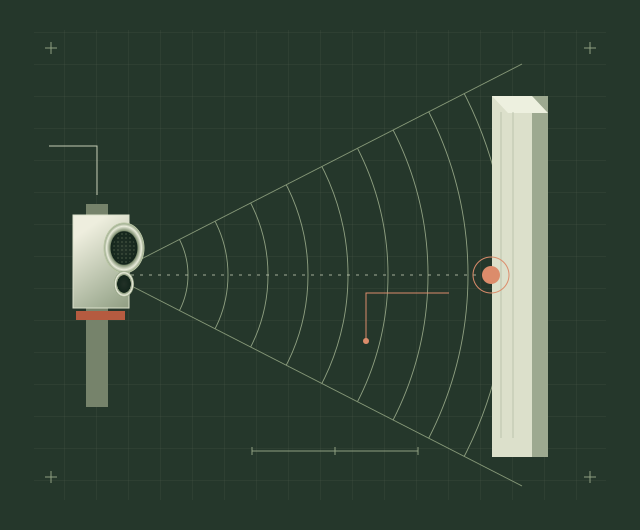
Signal study / Sense → respond
Conceptual distance sensor sending a fan of sensing lines toward an obstacle.
Distance → a useful cue.
Illustration of the research question, not a sensor measurement.
Platform
ESP32
Focus
Assistive sensing
Stage
Hardware prototype
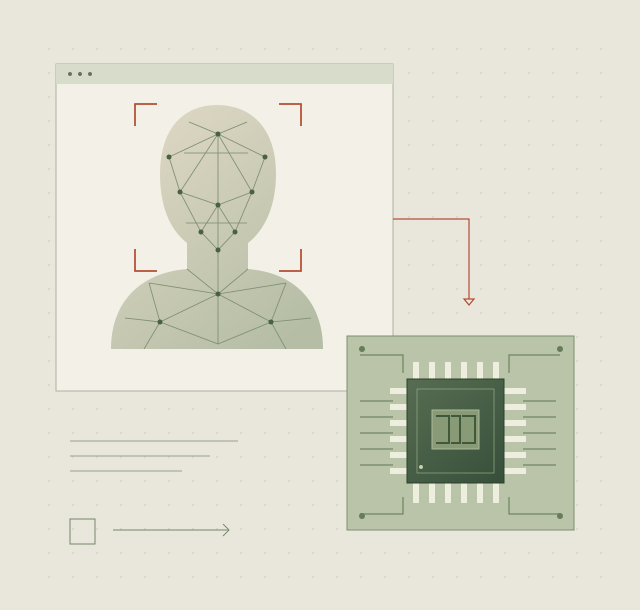
Perception study / Model → device02
An invented geometric portrait in a camera frame, connected to an illustrated chip to show a proposed embedded vision direction.
Illustrated research directionEmbedded deployment is a future goal.

03 / Perception

Collaborative coursework

Computer Vision

From a camera feed
to the edge.

The foundation is a collaborative face detection, age and gender estimation project at Vietnamese-German University.

Its documented pipeline combines YOLOv11s-face detection, a MobileNetV3 model and temporal smoothing, with ONNX and OpenVINO paths for desktop inference.

Research direction

Build on this foundation toward task-focused perception on embedded IoT chips, then explore how it could inform robotic systems. The first questions are memory, latency, power and what the model actually needs to recognise.

04 / Engineering method

Published skill

Proof-Driven
Engineering

Build the idea.
Question the result.

A coding-agent skill that connects requirements, implementation and verification evidence. Claims have to answer to what was actually checked.

The role ahead Carry that discipline into embedded experiments: state the question, measure the result, and keep the limits visible.

Read the method

The practice

Work you
can inspect.

A3GIS brings together agent infrastructure, engineering methods and applied research.

Public repositories hold the architecture, the implementation approach and the questions still open. The assistive hardware work adds a physical context to that inquiry.

Explore the repositories

Next comes the experiment

A direction becomes real
one question at a time.

Meet the practice →